
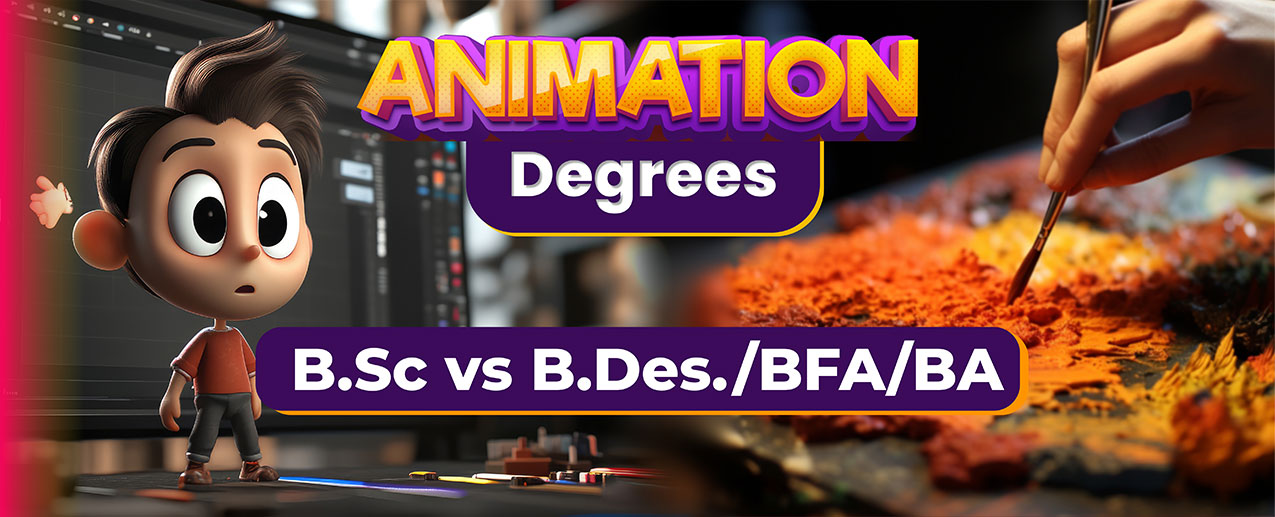
Types of Animation Degrees: B.Sc. vs B.Des. / BFA / BA
If you dream of bringing characters to life or designing virtual worlds, you’re already thinking like an animator!
Animation today goes way beyond cartoons; it’s shaping the future of entertainment, gaming, advertising and even education through cutting-edge technology and creativity.
With such huge demand, more students are now choosing animation as a career. But here comes the big question - which degree should you choose?
There are several options like B.Sc., B.Des., BFA and BA in Animation and each focuses on different aspects of the field. However, if you’re someone who enjoys technology, computer graphics and hands-on creative tools, the B.Sc. in Animation stands out as the most future-ready and industry-driven choice.
Why Choose B.Sc. in Animation?
1. Strong Technical Foundation
While BA and BFA programmes emphasise creative thinking, a B.Sc. in Animation focuses on the science and technology of animated expression. Students gain a deep understanding of:
- 3D modeling, rigging, texturing and rendering
- VFX, simulation and procedural animation
- Industry software like Autodesk Maya, Blender, Houdini, Unreal and Unity
This degree helps you not just learn to animate but also understand the why and how of motion, physics and computer graphics, turning you into a technically skilled creator.
2. Industry-Oriented Curriculum
The curriculum was created with the needs of the actual industry in mind. It combines technology and creativity, covering:
- Physics of animation and character movement
- Lighting, rendering and compositing
- Basics of coding for automation and tool development
- Real-time animation and virtual production
- AI-driven animation and procedural VFX
With this programme, you will be equipped for a wide range of creative and technical roles in animation, gaming and immersive media.
3. Career Versatility
It offers the flexibility to explore both technical and artistic directions in your career.
Technical Careers: VFX Artist, Game Developer, Simulation Expert, AR/VR Designer, Technical Artist
Creative Careers: 3D Animator, Motion Designer, Character Modeler, Layout Artist

4. Global Opportunities
Animation is a global industry and studios everywhere look for professionals who can blend creativity with strong technical skills. A B.Sc. in Animation helps students:
- Qualify for international roles in animation, gaming and VFX studios
- Pursue higher studies such as M.Sc., M.Tech or Master’s in Animation Technology
It also helps build a globally recognized skill set that keeps students aligned with the latest tools, techniques and global production standards, giving them an edge when working with top studios or pursuing advanced research in animation technology.
5. Future-Proof with Technology
The future of animation is tech-driven. New trends like AI-assisted workflows, real-time rendering and virtual production are changing how animation is created.
A B.Sc. in Animation prepares students to adapt to these changes by training them in AI-based automation (rigging, environment design and more), as well as in real-time engines like Unreal and Unity.
They also gain experience with virtual production tools used in major films and learn to create immersive experiences through AR, VR and XR.
Which Degree Is Right for You?
If your passion lies in design, sketching and storytelling, a BA or BFA in Animation might be your path.
However, if you enjoy combining creativity with technology, innovation and science, the B.Sc. in Animation is an excellent choice. It provides opportunities in both artistic and technical domains, preparing you to shape the future of animation and digital media.
Overall, a B.Sc. in Animation offers the right balance of creative learning and technical training, making it one of the most versatile and future-focused choices for anyone looking to build a strong career in animation.
Preethan K Babu
B.Sc Animation