
Choosing a B.Des in Interior Design is not just about liking décor or aesthetics. It is a commitment to a profession that blends creativity with technical execution, deadlines, and real-world constraints. Before you step into a Bachelor of Design Interior Design, there are a few realities you should be clear about.
It is not about "making spaces look pretty"
Interior design is widely misunderstood as decoration. In fact it is a discipline built entirely around problem solving through space . Every layout, material choice, and lighting decision has a functional reason behind it, not just an aesthetic one.
You will be expected to:
- Plan layouts based on human behaviour
- Ensure safety and functionality
- Work within structural and budget constraints
- Design for real users, not just visual appeal
If you enjoy thinking through how spaces work, not just how they look, you are in the right place.
You will spend more time doing than listening
A B.Des. in Interior Design is heavily studio-driven. Learning happens by making, and then remaking. Expect long hours, iterative work, and constant feedback that pushes your thinking further with every round.
What you should expect?
- Long hours of sketching and drafting
- Iterating the same design multiple times
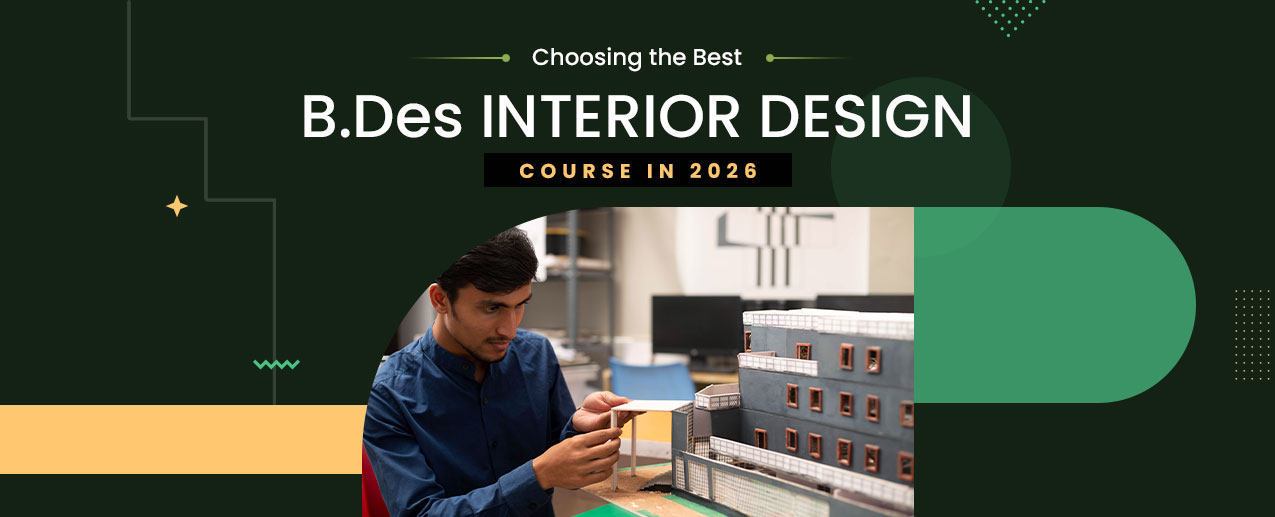
- Working on models, layouts, and presentations
- Continuous feedback and corrections
This is not a passive degree. Your growth in the interior design programme depends directly on how much you practise, build, and engage — inside and outside the studio.
Software is not optional. It is core to your skillset
From the first year, you will be working with AutoCAD, SketchUp, Revit, and 3ds Max. These are not supplementary tools added on at the end of the course. They are the professional standard across every interior design studio in India — and your fluency with them will directly determine the quality of career opportunities available to you after B.Des graduation.
These are not "add-ons." They are:
- Essential for drafting and modelling
- Required for internships and jobs
- A key factor in how industry-ready you are
Your portfolio matters more than your marks
In most careers, academic scores open doors. In interior design, your portfolio does. Every project you complete — from first-year exercises to final semester briefs — becomes part of the professional identity you carry into job interviews, freelance pitches, and client meetings.
Every project you work on becomes part of:
- Your job applications
- Your freelance pitches
- Your professional identity
A strong portfolio can outweigh average grades. A weak one can limit even high scorers.
You will deal with real-world constraints early
Unlike many other undergraduate programmes, a B.Des Interior Design introduces real-world limitations from the early semesters — not just at the end. Budget restrictions, material availability, client preferences, and site conditions are factored into briefs from the start.
This is precisely what makes the degree valuable. You are trained to design within constraints, not in controlled ideal scenarios. That is the skill that separates a professional interior designer from an enthusiast — and it is what employers and clients actually pay for.
It is a mix of creative and business thinking
Interior design is as much about managing projects as it is about designing them.
You will learn:
- Budgeting and costing
- Vendor coordination
- Documentation and approvals
- Client communication
This is what allows designers to grow into higher-paying roles and independent practice.
How ICAT's B.Des Interior Design prepares you from day one
At ICAT Design & Media College, the B.Des in Interior Design is built with these realities in mind. From the very first semester, students are immersed in hands-on learning, real-world project thinking, and industry-relevant tools — because the profession does not wait for you to ease in gradually.
The programme focuses on building not just creative ability, but the capacity to execute complete interior design workflows across residential, commercial, and hospitality spaces. Continuous portfolio development, structured software training in AutoCAD, SketchUp, Revit, and 3ds Max, and guided mentorship ensure that every student is developing with purpose and direction.
Regular portfolio reviews, industry exposure, and feedback from practicing professionals mean that by graduation, ICAT College students are not just someone who understands design — they are someone who can deliver it professionally, confidently, and at a standard the industry recognises.