
How AI Will Change Design Careers (And What Won’t Change)
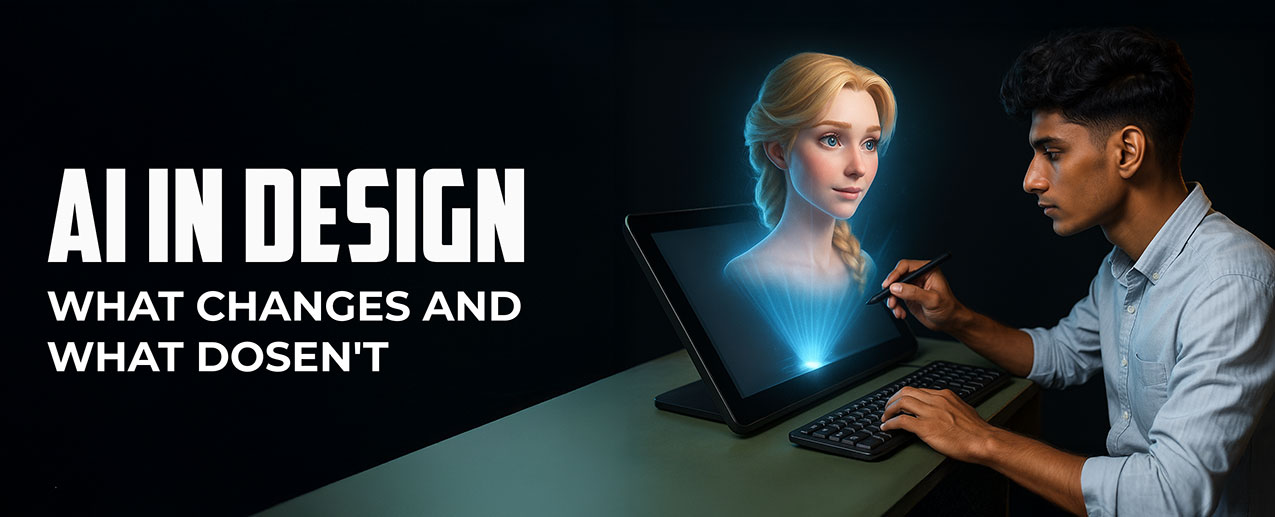
Have you noticed that every design tool now has an “AI” button? AI is everywhere, from generating layouts to suggesting colour schemes, and it’s changing how designers work faster than ever.
But students keep asking the same question: “If AI can make designs, what will designers do in the future?”
The answer is actually exciting.
Generative AI isn’t here to replace creativity; it’s here to boost it. Think of it as a super-fast partner who helps you ideate, fix mistakes, test concepts, and speed up the repetitive parts so you can focus on the real creative decisions.
Design tools of 2026 are built around human–AI collaboration, so if you’ve ever wished your software could think with you instead of just follow commands, you’re in the right era.
What Exactly Are AI Design Agents?
AI design agents are like small creative teammates built into your tools. They don’t just follow instructions — they understand goals, make decisions, and support an entire workflow from start to finish.
Here’s how it looks in action:
You: “I need a mobile app layout for a travel planner.”
An AI design agent:
- studies similar apps
- sketches a layout
- suggests colours
- generates icons
- prepares variations
All this before you even open a blank canvas.
Unlike traditional AI tools that produce one-off results, design agents behave more like assistants who understand the objective and stay with you until the task is done.
They can:
- analyse user needs
- create wireframes
- generate UI assets
- test usability
- refine flows
- prepare developer-ready handoffs
And the more you design, the more they learn your workflow and style.
Why Designers Still Matter (and Always Will)
With AI design agents evolving fast, it’s natural to wonder if designers still have a place. They absolutely do, and here’s why.
1. AI can generate, but designers can imagine
AI can mix patterns, follow rules, and produce results quickly, but it can’t create ideas rooted in culture, emotion, experience, or intuition. Designers bring the meaning and originality AI can’t replicate.
2. Designers understand people
Great design starts with empathy. AI analyses behaviour, but designers interpret it — the motivations, frustrations, and subtle human details behind the numbers.
3. Creativity needs direction
AI agents need goals, references, boundaries, and feedback. Designers lead the decision-making, give critique, and shape the creative direction. AI is the engine, but the designer remains the driver.
4. Strategy can’t be automated
AI can suggest colour palettes, generate layouts, and analyse user data. But when it comes to brand identity, storytelling, user psychology, and design ethics, it reaches its limit. These require judgment, emotion, and cultural understanding — the elements that make a product or brand feel human and trustworthy.
AI supports strategy, but it can’t define what a brand should stand for. Designers provide the vision, context, and meaning.
5. Originality is still a human superpower
AI can create endless variations, but designers know how to choose the right direction and turn it into something meaningful. As workflows speed up, the demand for designers who can think critically and creatively actually increases.
In the end, AI may speed up the process, but the heart of great design still comes from human clarity, creativity, and decision-making.
That’s why strong core skills matter more than ever.
At ICAT, students develop those fundamentals: design principles, visual storytelling, user behaviour, and the thinking behind each creative choice.
So even as tools evolve, the foundation stays solid. When designers know their basics, AI becomes a support system, not a shortcut.
This is what keeps their work original, thoughtful, and unmistakably human, no matter how fast the industry changes.