
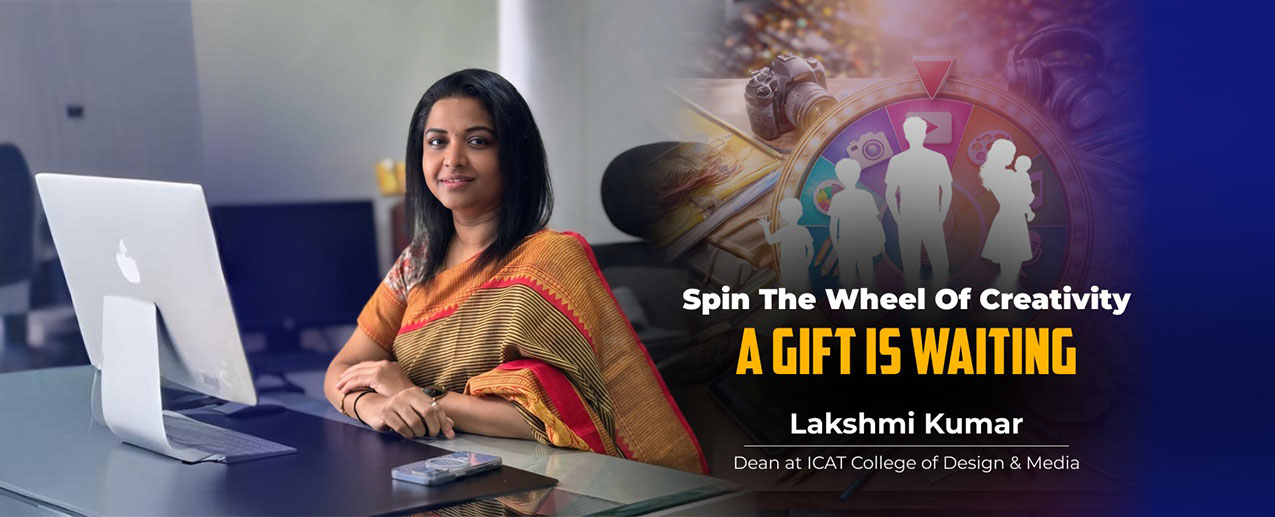
Spin the Wheel of Creativity: A Gift Is Waiting
The wheel of creativity turns for everyone, as creativity belongs to all. Creativity has no age limit, no caste, no creed, no language, and no social boundary. It does not ask who you are, where you come from, or what status you hold in society. Creativity simply exists within every human being, waiting to be expressed. If we truly spin the wheel of creativity, we discover something remarkable: this fundamental human capacity belongs to everyone.
The first act of creativity does not begin in a classroom. It begins when an infant picks up a crayon and makes the first scribble — the earliest mark of pure expression. That scribble is not meaningless; it is instinct becoming visible.
When a child draws on a house wall, filling it with shapes, faces, and imagined stories, adults may see mischief. But in truth, the child is exploring imagination, observation, and identity in their purest form, untouched by rules, untouched by judgment. Creativity is not a supernatural gift granted to a chosen few. It is an inborn human instinct, present from our earliest attempts to understand the world.
Creativity recognises no hierarchy
Creativity does not recognise social hierarchy or economic status. An elderly grandmother creating a pulli kolam or rangoli at dawn is practising design thinking. A street artist sketching with charcoal on a wall is expressing visual storytelling. A person struggling with mental health may draw emotions that words cannot describe. Creativity appears in different forms: art, design, technology, movement, storytelling, problem-solving, and imagination. It does not ask whether someone is rich or poor, educated or illiterate. Creativity only asks one question: "What do you see differently?"
According to research on creativity frameworks, the wheel of creativity operates as a 12-stage methodology that helps individuals identify where they are in relation to the life they want to create. It guides people through four distinct quarters: vision (what do I want?), exploration (what resources are available?), incubation (what is beyond my control?), and cultivation (what action is required?). This structured approach demonstrates that creativity is not random inspiration but a learnable process accessible to all.
Creativity of past generations
In earlier generations, creativity often went unnoticed and undervalued. Parents prioritised stability over imagination, and academic success was seen as the only path to survival. Children who excelled in mathematics or language were praised, while those who drew, designed, or imagined differently were often told: "Focus on real studies." Many creative minds remained hidden because creativity was not recognised as intelligence. The cost of this oversight was immeasurable — countless potential innovators, artists, and visionaries were discouraged from pursuing their areas of interests.
Today's generation, especially Gen Z, is witnessing a profound transformation. Parents are slowly beginning to understand that creativity is not distraction; it is capability. Photography, animation, video editing, gaming design, VFX, fashion, interior design, UI/UX, and digital storytelling have become powerful professional fields. What was once called a hobby has become a career path. Creativity has moved from the margins into the mainstream, reshaping how society values different forms of intelligence and contribution.
Redefining intelligence
Who decided that students weak in English or mathematics lack intelligence? Creative thinkers often operate in a different thinking language — a visual, spatial, or conceptual language. Many inventors and creators throughout history did not rely on perfect grammar or academic excellence to innovate; they thought through ideas, observations, and experimentation. Innovation does not always begin with words; sometimes, it begins with imagination. Educational research indicates that developing a shared language of creativity helps students reflect, self-assess, and value their own creative capabilities, transforming how we measure and recognise intelligence.
Creativity is not limited to artists or designers. It exists when someone rearranges a small home to make space feel larger, when a tailor designs a new pattern from leftover fabric, when a cook experiments with flavors, when a photographer captures emotion in a single frame, or when a child builds stories from simple objects. Creativity lives quietly in everyday actions, often unrecognised. These mundane expressions of creativity are as valid and important as those celebrated in galleries or studios.
The modern world has transformed creativity into entire industries: photography and filmmaking, animation and VFX, graphic and communication design, fashion and interior design, digital media and content creation, and game design and interactive technology. What society once ignored has now become economic power. Creativity is no longer optional — it drives innovation, culture, and industry. Nations and businesses that cultivate creative talent gain competitive advantage in an increasingly complex global economy.
A world without creativity
Imagine a world without creative thinking. No cinema, no architecture, no technology design, no storytelling, no music, no innovation. Without creativity, progress stops. Society becomes mechanical, repetitive, and silent. Creativity is not decoration; it is evolution itself. Every advancement in human civilisation, from the wheel to artificial intelligence, began with someone asking "what if?" and daring to imagine differently.
The real question today is not whether creativity exists. The question is whether we are ready to recognise it. Are we encouraging creative minds early enough? Are education systems valuing imagination equally with memorisation? Are we nurturing thinkers, or only examination scorers? A nation grows when creativity is cultivated, not suppressed. The future belongs to societies that understand creativity as essential infrastructure, not luxury.
When the wheel of creativity spins, it reveals curiosity, imagination, courage to express, diversity of thought, innovation, human emotion, problem-solving, and identity. The wheel of creativity serves as a formative assessment tool, helping individuals develop a shared language of creativity and reflect on their own creative development. Every rotation brings a new possibility; every turn deepens understanding of creative potential.
Creativity does not belong to a classroom, a degree, or a profession. It belongs to humanity. Every person born into this world carries creativity in their own unique form. Some paint it, some design it, some build it, and some imagine it. Creativity must not be judged; it must be grown. Because when creativity grows, society moves forward. And when the wheel of creativity keeps spinning, the future keeps evolving.