
Fashion today is being shaped as much by fashion influencers and digital creators as by traditional designers. Social media platforms have transformed fashion into a powerful medium of self-expression, entrepreneurship, and global storytelling. From styling content and sustainable fashion advocacy to personal branding and online fashion businesses, the industry now demands professionally trained creative minds rather than trend followers alone.
This shift has encouraged many students to explore a fashion design course through reputed fashion design schools and leading fashion design colleges like ICAT College of Design and Media that combine creativity with industry exposure. Students frequently search for fashion design schools near me or fashion design colleges near me, reflecting the growing awareness that structured education is essential to succeed in today's competitive fashion ecosystem.
Eligibility for Undergraduate Fashion Design Programs
For students considering fashion designing courses after 12th, eligibility typically includes completion of higher secondary education from any stream-Arts, Commerce, or Science. Popular undergraduate pathways include a bachelor of fashion design, bachelor of arts in fashion design, BSc fashion designing, or BSc in fashion, all of which build strong creative and technical foundations through industry-oriented fashion design programs.
In today's fashion-conscious world, a bachelor's degree in fashion design provides expanding opportunities in design leadership, fashion communication, styling, entrepreneurship, and global fashion markets. Whether choosing a fashion designing course near me or evaluating top colleges for fashion design, students must demonstrate creativity, observation skills, and visual thinking alongside academic eligibility. Today, a fashion design degree prepares students not only to design garments but also to influence culture, build brands, and shape the future of fashion in a digitally driven world.
Creative Aptitude Expectations
While academic eligibility forms the basic entry requirement, admission into a fashion design course largely depends on a student's creative aptitude and design sensibility. Successful fashion aspirants demonstrate creativity, imagination, visual sensitivity, originality, basic drawing ability, and an interest in fashion, art, and culture, along with a developing sense of colour, form, and proportion. Students exploring fashion design schools or colleges for fashion design should understand that passion and creative potential often hold greater importance than academic stream.
At ICAT College of Design and Media, Bangalore this creative aptitude is not only recognized as an eligibility factor but is continuously nurtured and refined through experiential learning practices that bridge classroom education with real-world exposure. One such initiative is the periodic Market Survey Visits, designed to immerse students in professional fashion and art material markets. These visits ranging from local market like Chickpet to mall visit or an artisan market like Karnataka Chitrakala Parishath enable learners to understand material availability, texture, durability, pricing structures, and functional applications while gaining practical exposure to vendor interaction, sourcing strategies, and procurement practices. By engaging directly with textiles, crafts, and contemporary materials, students begin to connect theoretical design principles with cultural influences, consumer behaviour, and industry realities-strengthening observational and analytical skills essential for designers.
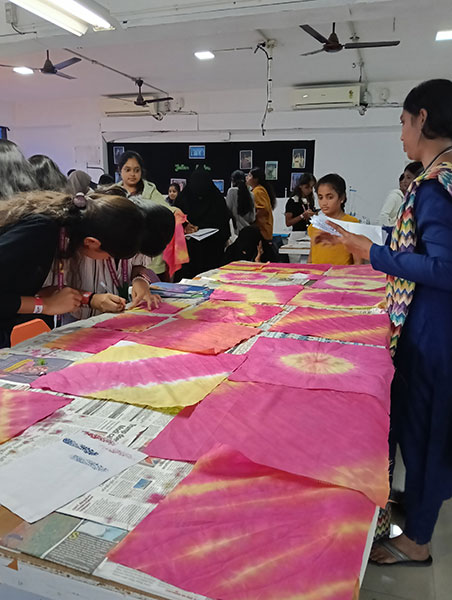
Complementing this exposure are immersive craft-based exercises such as the Tie and Dye workshop, which introduces students to India's rich textile treatment heritage. Through hands-on exploration of resist-dyeing techniques including tying, folding, twisting, and binding, students experiment with colour interaction, pattern development, and material response. Rooted in traditional practices like Bandhani and Leheriya, the workshop fosters creativity while encouraging sustainability awareness and cultural appreciation.
Together, these learning platforms ensure that while creative aptitude enables students to enter fashion education, ICAT provides the environment to sharpen imagination, enhance design thinking, and transform creative potential into professional competence, preparing students to emerge as culturally aware and industry-ready fashion designers.
Conclusion
The eligibility criteria for fashion design courses extend beyond academic qualifications. Whether students pursue a bachelor of fashion design, Fashion education is inclusive, interdisciplinary, and future-oriented. Students from all streams can pursue fashion design degrees and build careers across design, entrepreneurship, sustainability, fashion technology, retail, branding, research, and global fashion industries.
In today's evolving creative economy, fashion design is not just a course-it is a professional ecosystem. Understanding eligibility is the first step, but success is shaped by vision, discipline, skill development, and purpose. Fashion education empowers students not only to design garments, but to shape culture, identity, and innovation in the global fashion landscape.