

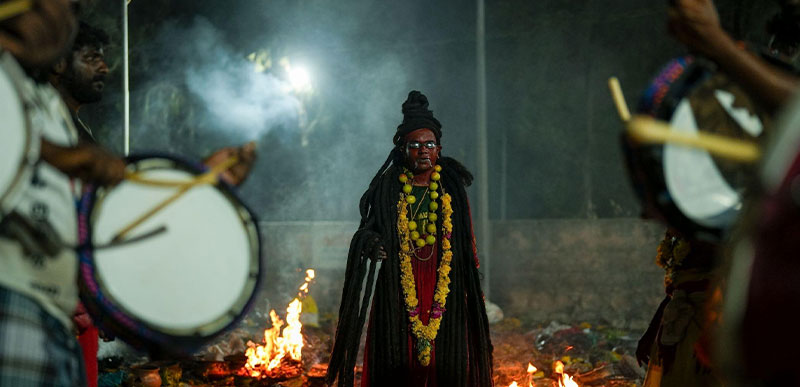
Figure 1. Encircled by drums and fire, the devotee stands at the threshold - where rhythm becomes trance and faith becomes identity. (Photo by JVR Srihari)
Every year, as the coastal town of Kulasekarapattinam in Thoothukudi district of Tamil Nadu prepares for Dussehra, the ordinary dissolves into the extraordinary. Streets become ritual pathways, bodies turn into living canvases, and devotion erupts in raw, theatrical form. 'Kulasai Dussehra' is not a spectacle staged for the camera; it is a deeply lived ritual. Photographing it demands far more than technical skill – it calls for patience, sensitivity, and an instinct for storytelling. This essay is based on my photography project which I undertook for my undergraduate studies with passion.
Unlike processions that unfold in neat frames, Kulasai Dussehra is unpredictable and intense. Devotees transform into gods, goddesses, demons, and mythological figures, most famously fierce forms of Kali, as an act of surrender to Goddess Mutharamman. (The worship of Mother Goddess is common across India, which includes that of Goddess Durga.) Unlike most festivals of goddesses, Kulasai Dussehra is gender inclusive and many men don female attire.
Preparation phase
For a photographer, the challenge begins well before the first frame is exposed. Understanding the rhythm of the festival – its rituals, timings, and emotional peaks – is essential. Pre-production here means walking the ground, observing light conditions at different hours, and listening to local voices.
One of the most powerful phases to photograph is preparation. At the seashore, devotees perform cleansing rituals before applying makeup and donning costumes. These moments are intimate and quiet, offering opportunities for close portraits. A standard prime lens allows the photographer to stay unobtrusive while isolating expressions – eyes closed in prayer, and hands trembling as paint is applied. Shallow depth of field helps to separate faces from chaotic backgrounds, guiding the viewer to the human core beneath the costume. Under the trembling glow of ritual fire, a mortal body undergoes a mystical transformation - where paint, pain, and prayer merge, and the goddess breathes through human flesh.
As the day advances, the festival spills into motion. Drums pound, chants rise, and the transformed devotees walk long distances in trance-like states. Here, wide-angle lenses come into their own. They capture the density of the crowd, the scale of devotion, and the relationship between individuals and their environment. Low shooting angles intensify the stature of performers, making them appear larger than life, while high vantage points reveal patterns – processions going through streets, and colour surging.
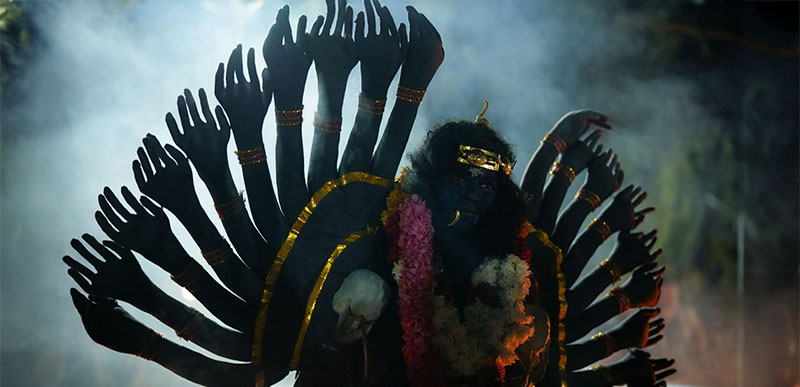
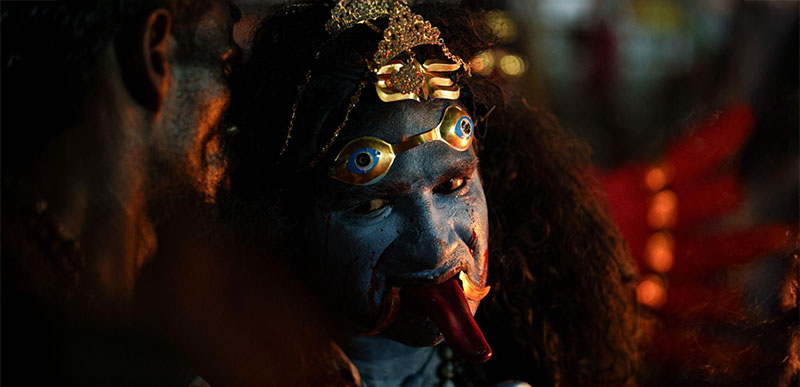
Figures 2 & 3. In the shadows of smoke and ritual, mortals become goddesses, and devotion transforms the bodies into belief. (Photos by JVR Srihari)
Light at Kulasai Dussehra is both a gift and a trial. Harsh midday sun exaggerates textures. Cracked paint, sweat-streaked faces, and smeared ash add grit to the narrative. As evening falls, available light drops sharply, replaced by fire rituals and sparse bulbs. Rather than overpowering the scene with flash, working with low light preserves mood. High ISO performance and fast lenses allow photographers to keep shutter speeds workable, freezing gestures mid-chant or mid-stride while retaining the atmosphere of dusk.
Crowd management is another crucial technique, though it is less about control and more about anticipation. The best images often happen on the edge of action – just before a devotee breaks into a run, or in the pause after an outburst of energy. Reading body language becomes a skill equal to adjusting exposure. Staying mobile, switching between lenses quickly, and trusting instinct are key when the scene changes in seconds.
Aerial perspectives, when used responsibly, add a narrative layer rather than novelty. The festival's scale becomes clear: thousands moving with a shared purpose, the temple acting as a magnetic centre. Such images function as visual punctuation, giving viewers a breath between close, emotionally charged frames.
Post-production is where technique meets restraint. Colour grading must respect the festival's palette – deep reds, stark blacks, and ash whites. Sequencing images is as important as editing individual frames. A strong photo essay allows readers to experience the festival's emotional arc.
Clicking with sensitivity
Yet the most important technique cannot be found in a camera manual. It is respect. Kulasai Dussehra is not performed for documentation; the camera is a guest. Seeking consent through gesture, maintaining distance during moments of deep trance, and knowing when not to shoot are ethical choices that shape the final work. Images made with sensitivity carry a different weight. They invite understanding rather than mere curiosity.
For a photographer, Kulasai Dussehra is a reminder of what the medium does best. At its core, photography freezes time, but here it also reveals transformation. The lens captures not just colour and motion, but belief made visible. In the clash of drums, fire, and flesh, photography connects those who live the ritual with those who will encounter it only through images. That is the true power of photographing Kulasai Dussehra: turning devotion into a visual story.