
The global video game industry is expanding at a remarkable pace, opening up career opportunities for students, designers, programmers, and artists. From mobile puzzle games to large celluloid adventures, games today are built with the help of powerful software systems known as game engines. These engines make the complex process of game creation easier by providing ready-made tools for design, programming, and visual effects.
For anyone entering the field of game development, choosing the right game engine is a crucial first step. The engine a developer selects influences how quickly a game can be built, how smoothly it runs, and how easily the development team can collaborate. Selecting the wrong engine can slow down production and create technical limitations.
Graphics engines create realistic environments and characters, physics systems manage movements and collisions, and audio tools handle music and sound effects. Asset management features also allow developers to organise images, models, scripts, and other resources. By providing these integrated tools, a game engine saves developers enormous amounts of time and effort.
Choosing the right engine is important for several practical reasons. First, the right engine can significantly speed up the development process. Developers can focus on creativity and storytelling rather than spending time writing low-level code. Second, a suitable engine reduces technical errors and compatibility problems, ensuring that the game performs smoothly across different devices.
'Unity' Game Engine
Among the many engines available today, a few have become particularly popular in the industry. One of the most widely used engines is 'Unity'. Known for its flexibility and ease of learning, 'Unity' is widely used by students, indie developers, and professional studios alike. It supports both 2D and 3D game development and uses the C# programming language.
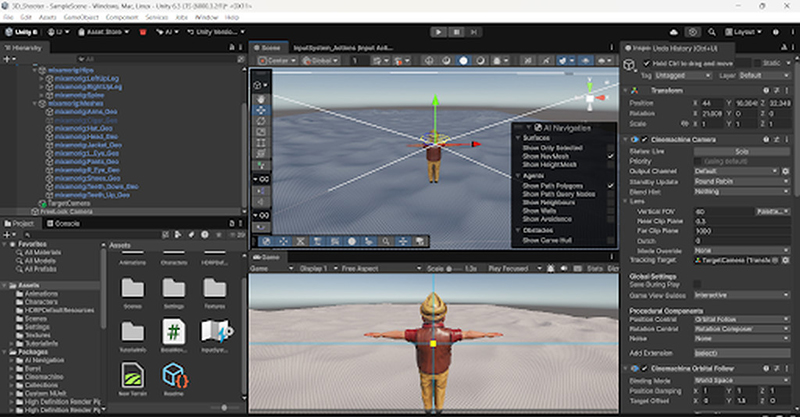
Figure 1. A game scene in 'Unity Engine'.
'Unity' is especially popular for mobile game development because it supports multiple platforms such as Android, iOS, PC, consoles, and even virtual reality. For students who are just entering the field, 'Unity' serves as the first practical introduction to game development. Another powerful engine is 'Unreal Engine', which is famous for its high-quality graphics and celluloid visual effects. Developed by the Epic Games, 'Unreal Engine' is widely used for large-scale commercial games and visually impressive projects.
This engine uses the C++ programming language, but it also offers a visual scripting system called Blueprints that allows developers to design gameplay mechanics without writing extensive code. Because of its advanced rendering capabilities, 'Unreal Engine' is often used for high-end games, film production, and virtual production environments.
At the ICAT College of Design and Media, students are trained using industry-standard game engines which include 'Unity' and 'Unreal Engine'. Through hands-on projects, the students learn to design and develop games, helping them build strong portfolios and gain the skills needed for placements in leading game development companies.
Open-source engine
A different approach to game development can be found in 'Godot', a free and open-source engine that has gained popularity among independent developers. 'Godot' is lightweight, flexible, and easy to learn, making it ideal for smaller projects and experimental ideas. 'Godot' is completely free and does not require royalties or licensing fees. It is particularly well suited for 2D games and small indie projects, although recent versions also support advanced 3D features. Developers can modify the engine to suit their needs.
For simple 2D game development, 'GameMaker' is a beginner-friendly option. It offers drag-and-drop tools that allow users to create games without deep programming knowledge, making it ideal for students who want to prototype ideas quickly and learn the basics of gameplay design.
Before choosing an engine, developers should consider several factors. The first factor is the type of game they want to create. If the project involves simple 2D gameplay, engines like 'GameMaker' or 'Godot' may be sufficient. However, for large 3D environments or visually rich worlds, 'Unity' or 'Unreal Engine' may be more appropriate.
Programming experience is another important factor. Beginners often prefer engines that offer simple scripting systems or visual tools. 'Unity' and 'Godot' are considered beginner-friendly, while 'Unreal Engine' may require stronger programming skills. 'GameMaker' is particularly helpful for those who want to begin without extensive coding.
Platform compatibility
Platform compatibility also plays a major role in engine selection. Developers should decide whether their game will run on mobile devices, personal computers, consoles, web browsers, or virtual reality systems.
Ultimately, there is no single "best" game engine for everyone. The ideal choice depends on the developer's goals, technical skills, and the type of game being created. Beginners may start with 'Unity' or 'Godot', professional studios may prefer 'Unreal Engine' for high-end visuals, and simple 2D projects may be well suited for 'GameMaker'. By selecting the right engine and learning its tools effectively, aspiring developers can transform creative ideas into immersive interactive experiences.