
We explored the project 'Serpent' created by the visual effects students. The project began with a brief assigned to the students: "Employ digital technology, drawing from two years of diverse module techniques studied to complete your project." Students were required to document their creative journey through an RVJ (Reflective Visual Journal), which serves as a record of their ideas, processes, and final outcomes.
Ideation and Concept Development
The ideation phase started with mind mapping. Each student created individual mind maps, often revolving around common inspirations such as films, storybooks, and news, and also driven by the central question: "What if?"
One of the key conceptual triggers was "What if there were no trees?" This led students to conduct further research and document their inspirations in their RVJs. Each student developed his/her own short film idea and presented it before the faculty members.
A faculty committee reviewed and discussed these ideas. While several concepts were impressive, time constraints required careful selection. 'Serpent' emerged as one of the most promising and ambitious ideas.
Pitch and Story Evolution
The concept revolved around a mythological narrative featuring a two-headed serpent and a quest for a mystical object. Inspired by the myth of Parkadhal (the churning of the ocean), the story incorporated elements of conflict between divine and demonic forces.
Initially, the story followed two archaeologists, but it was later refined into a more engaging concept involving two myth-buster vloggers searching for the Sudarshana Chakra of Lord Vishnu. This artifact was believed to be guarded by a powerful serpent on a mysterious island in the Bay of Bengal.
One-Line Concept
Two myth-buster vloggers travel to a remote island in the Bay of Bengal in search of Lord Vishnu's Sudarshana Chakra, only to encounter a deadly serpent guarding the ancient relic.
Pre-Production
During the pre-production phase, students attended filmmaking masterclasses, which helped them refine their storytelling and technical approach.
The team planned to include a tribal backstory, complete with 2D animation sequences depicting the evacuation of the island. Concept art and costume designs for the tribe were also developed.
Scene Breakdown
The story was structured into 13 scenes, covering locations such as rivers, forests, caves, waterfalls, and underwater environments. Key events included creature attacks, environmental transitions, myth exploration, and the final confrontation with the serpent. Seven of these scenes needed to be taken inside a boat.
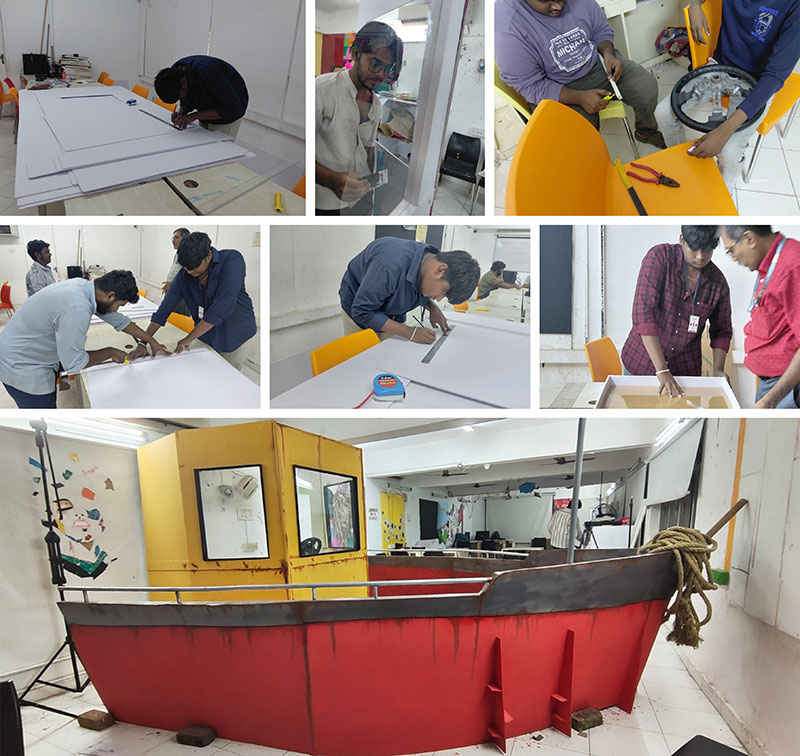
Figure 1: The make of the boat.
Production Challenges
A significant portion of the film required boat-based scenes. The team explored real boat rentals at Kasimedu Fishing Harbour, but logistical challenges and high costs made it impractical.
This short film was written and directed by Kushal S, comprising a team of five students collaboratively contributing to its successful completion. Noel Kunjumon worked as the concept artist and storyboard artist and also supported both live-set and 3D boat set creation. In addition, he appeared as a supporting actor in the film. Pradhiban R contributed as a 3D artist, while Santhosh V handled compositing and editing. Thanga Murugan was responsible for constructing the live boat set and also contributed to rotoscoping. Kushal, apart from directing, worked as a compositor for the project.
The team decided to construct a physical boat set. A large indoor space was allocated, and the students successfully built a live-action boat set for filming.
Casting and Shooting
Casting included actors from an acting school, as well as a student's father for a supporting role. Noel also performed in the film.
The shoot was conducted in locations such as Tada, along with green screen setups and the custom-built boat set. (Tada Falls is located in the Tirupati district of Andhra Pradesh, and is 95 km from Chennai.) The production used a Sony FX6 camera.
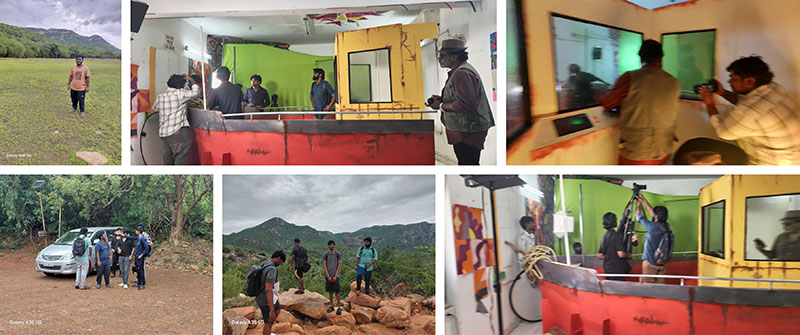
Figure 2: Location shooting mingled with VFX scenes.
Post-Production
Post-production involved editing, compositing, and visual effects integration. Santhosh led the editing process, while all team members contributed to various aspects of post-production. The SFX and music were done by Z Music.
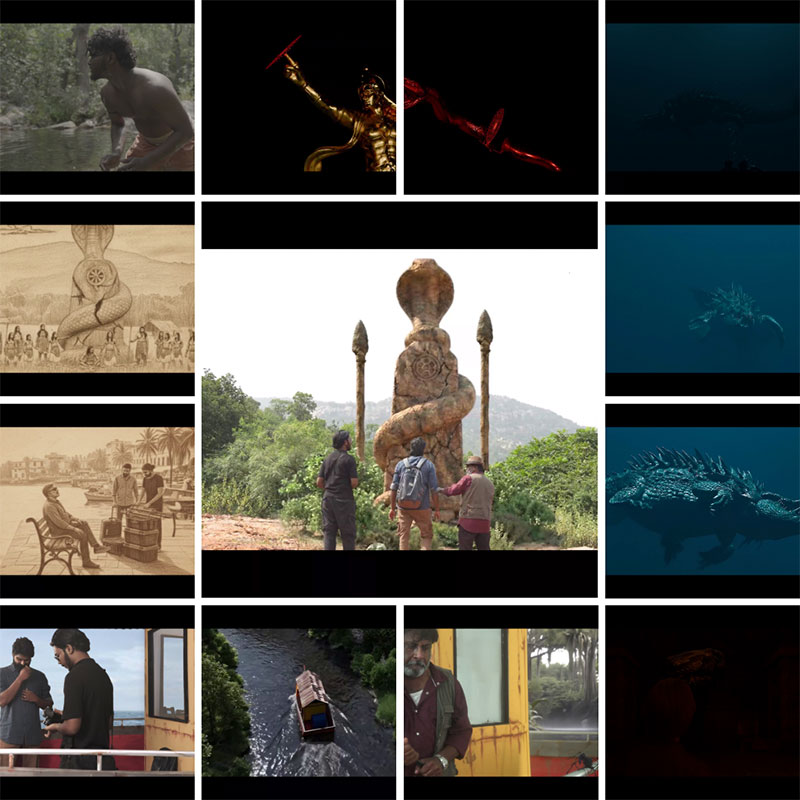
Figure 3: The post-production including that of the mythical serpent.
Conclusion
'Serpent' stands as a strong example of collaborative filmmaking and practical VFX learning. From concept development to execution, the project reflects the students' ability to integrate storytelling, technical skills, and creative problem-solving within real-world constraints.
The project not only demonstrates their technical proficiency but also highlights their dedication, teamwork, and innovative approach to visual effects filmmaking.