

Learning at ICAT College of Design and Media, Chennai, offers far more practical experiences than theoretical teachings. It mirrors the rigorous conditions of the real-world creativity industry, emphasising studio experience over classroom sessions. The college follows a "learning by doing" philosophy, where guidance from experienced instructors ensures a smooth transition from theory to practice. Within this immersive environment, the concept of a "oner" (or "one-er")—a filmmaking technique where an entire scene unfolds in a single continuous take without cuts—naturally aligns with the college's emphasis on precision, coordination, and hands-on mastery. Just as a oner demands complete control over timing, movement, and performance, ICAT's pedagogy encourages students to think holistically and execute ideas seamlessly from start to finish. The Department of Visual Media is a unique blend of versatility, where I developed into a multi-skilled media professional. The degree programme follows an educational process I completed, starting from basics like colour theory and semiotics (study of signs), then building skills in digital media, advertising, and film studies—what makes this department so interesting and promising for students today. In the department, I learned about various media types and gained skills in both traditional forms, such as photography and journalism, and modern digital media production and management techniques.
In terms of achievements, one of the biggest milestones in the Visual Media programme is the pilot film or short film produced in the final year. This intense assignment serves as a key portfolio piece for the student. It demands great professionalism, covering all aspects of filmmaking—from pitching ideas and scriptwriting in pre-production to coordinating the technical team during production. With ICAT's state-of-the-art equipment—including high-end cameras, advanced LED lighting rigs, and green screen studios—students gain full control over their vision.
In a Single Breath
"Oner" (or "one-er") in filmmaking means a scene or entire sequence shot in one continuous take without any cuts. It is also called a single-take shot or long take. Famous examples include long sequences in films like 'Birdman' (which is made to look like one continuous shot). In this student production of oner, the film is named 'APATE'.
From the outset, my vision for the ICAT project was clear: to create a film with no cuts—a true oner. This goal positioned me as cinematographer and Karnika M as director for our final-year film. We broke from conventional filming, which relies on multiple angles for coverage. Our chosen oner demanded meticulous perfection to be technically sound. This tasked me with ensuring the camera actively helped tell the story.
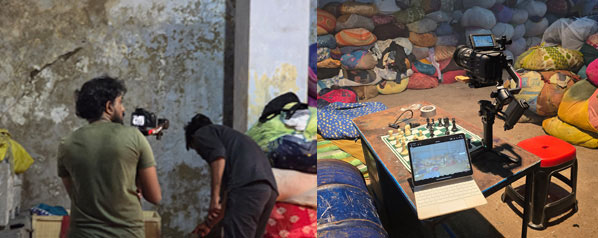
Figure 1: Cinematographer Akshay Ashok Kumar with the camera.
The pre-production stage was the toughest yet most crucial part. We spent an extensive period in thorough planning, arranging every detail of the space for a camera in constant motion. In coordination with Karnika M, I devised a detailed "dancing" process between the actors and the camera. With no editing to fix framing or lighting errors, I had to memorise the entire 11-minute sequence. We ran hundreds of "dry run" rehearsals without a camera to perfect synchronisation between actors' timings and my camera movements for the short film 'APATE'.
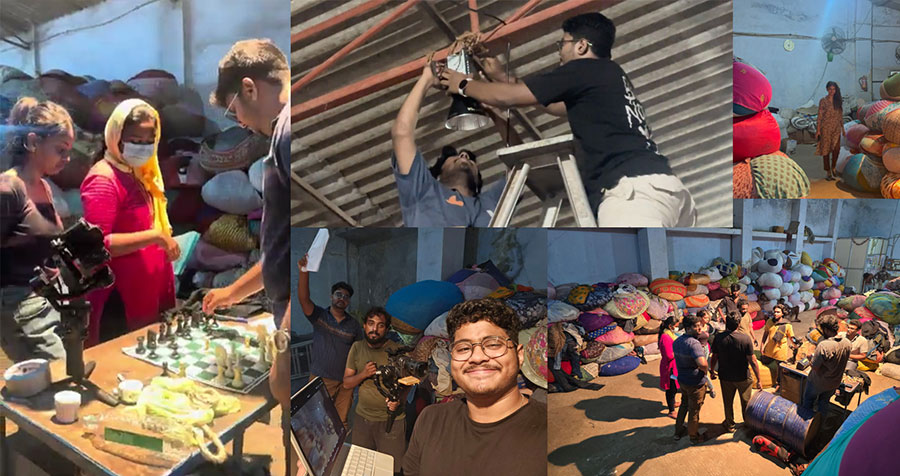
Figure 2: Preparation for the shoot.
The moment we started filming, tension filled the air—in a good way. Filming an eleven-minute sequence felt like a marathon for the cinematographer. Every moment mattered to keep the frame stable and well-composed. Thanks to our faculty, we learned that real-time problem-solving is critical in filmmaking. If an actor shifted a few inches from position, I had to adjust on the fly without breaking continuity. I hoped the lighting technicians did the same behind me. After nailing the "perfect take", Karnika M and I faced post-production challenges. In conventional filmmaking, editing creates rhythm through cuts. But in one-take filmmaking, editor Parthipan's role shifted to enhancing the shot's inherent rhythm. I handled colour grading smoothly, drawing on years of training to maintain lighting consistency as the camera moved through spaces, while we layered sound design to replace editing. Post-production perfected these "hidden" aspects, keeping the viewer engaged in the unbroken reality.
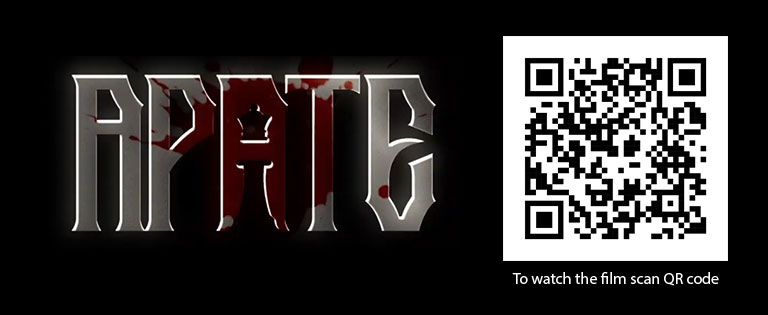
Figure 3: QR code to watch 'APATE'—the 11-minute short film with only one shot.
In retrospect, the film's success highlighted teamwork and ICAT's support. This seemingly impossible technical challenge became a standout piece showcasing our collaboration. Whether Karnika's directing skills, Parthipan's precise editing, or my camera work, we proved continuous shots are not just a gimmick—they are the purest form of storytelling. This experience strengthened my technical skills and deepened my appreciation for film collaboration. As of 2026, 'APATE' remains a proud portfolio highlight from my ICAT journey.