
Explore the making of Rajpura Files, a psychological horror game set in a Rajasthani haveli. Discover its art direction, trimsheet workflow, and cultural storytelling making 400-year-old haveli feel genuinely terrifying.
I was scrolling through archival photographs of Rajasthani havelis watching impossibly detailed carved sandstone facades pass by and thinking "No one has ever put this in a horror game. Not properly. Not with the weight and specificity it deserves."
That feeling of standing in front of a door no one else has walked through became the foundation of everything that followed in Rajpura Files.
What Is "Rajpura Files"?
Rajpura Files is a first-person psychological horror game set in a crumbling haveli in Rajasthan.
The story follows Dev Singhania, a 32-year-old bank manager who receives a letter stating he is the last male heir of a royal bloodline where every male heir before him has died at 33. He is summoned to his ancestral home, the Singhania Haveli in Rajpura, with less than a year to live.
I worked as both the Game Artist and Designer, responsible for translating vision into a playable world leading visual research, moodboarding, and defining the overall art direction. Alongside, Hanu as a Technical Artist & Environment Artist, Sai Tharun as a Developer
The Research That Changed Everything
Before building a single asset, I spent weeks researching across digital archives and architectural references. What I found confirmed something important:
Indian havelis are almost completely absent in mainstream horror games.
While Silent Hill built its identity on fog-covered American towns and Resident Evil on European mansions, the Rajasthani haveli with its layered courtyards, carved sandstone, and cultural depth remains unexplored.
This wasn’t just a gap, it was an opportunity.
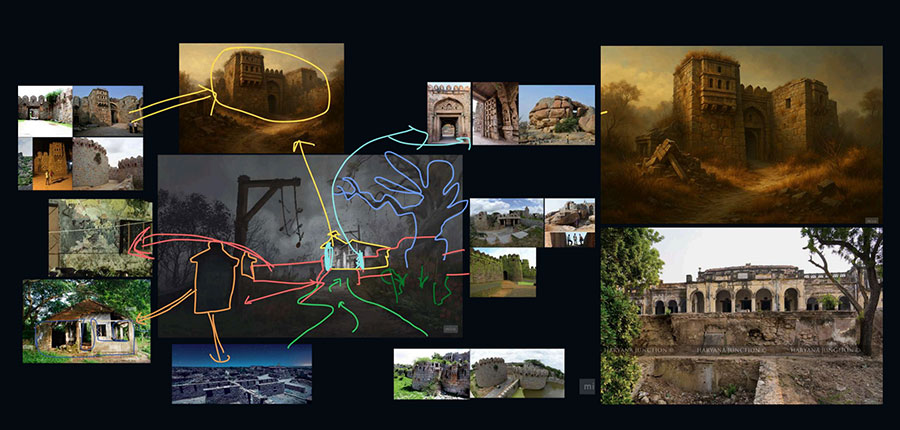
Using tools like Miro, I built a reference library filled with:
- Archival photography
- Heritage documentation
- Architectural studies (jharokha, jaali, chowk)
- Light behavior on sandstone
This wasn’t generic research. It was about understanding specific structures, aging, decay, and atmosphere.
Trimsheets: The Technical Heart of the Pipeline
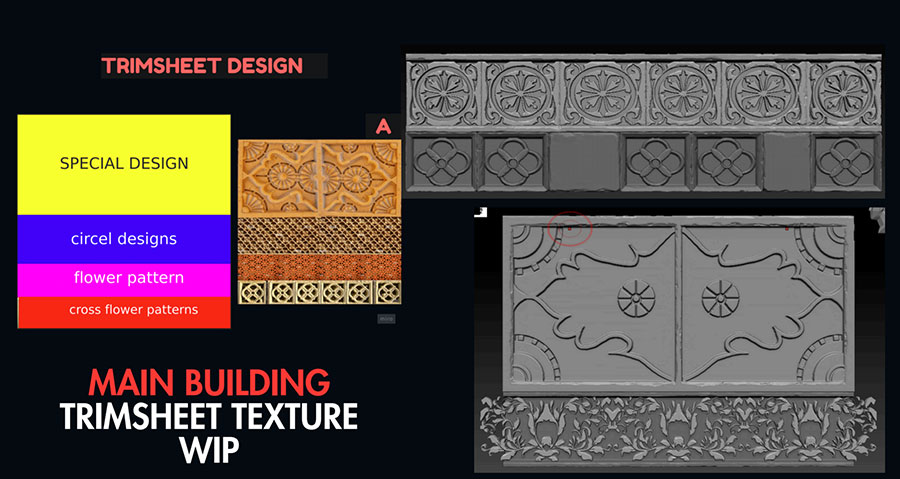
The most technically complex part of the pipeline was the trimsheet. A trimsheet is a texture atlas typically 2K or 4K containing tiling surface details like edges, damage, carvings, and material variations, all applied through UV mapping.
For Rajpura Files, this required specialization.
Rajasthani sandstone has:
- A warm terracotta/cream palette
- Unique weathering patterns
- Distinct carved textures
- Desert-specific aging behavior
Using Substance Painter, I built:
- A procedural stone base
- Weathering layers specific to sandstone
- Grunge maps for dust and stains
Normal maps enabled parallax occlusion mapping in Unreal Engine, allowing depth without additional geometry.
The trimsheet layout went through multiple iterations but ultimately allowed visual consistency across dozens of assets, making it efficient for a three-person team.
Props as Sentences
Environmental storytelling was driven through props.
Each object wasn’t just modeled, it told a story.
- A fallen oil lamp suggests disruption
- A pulled chair implies urgency
- A sealed letter drives narrative
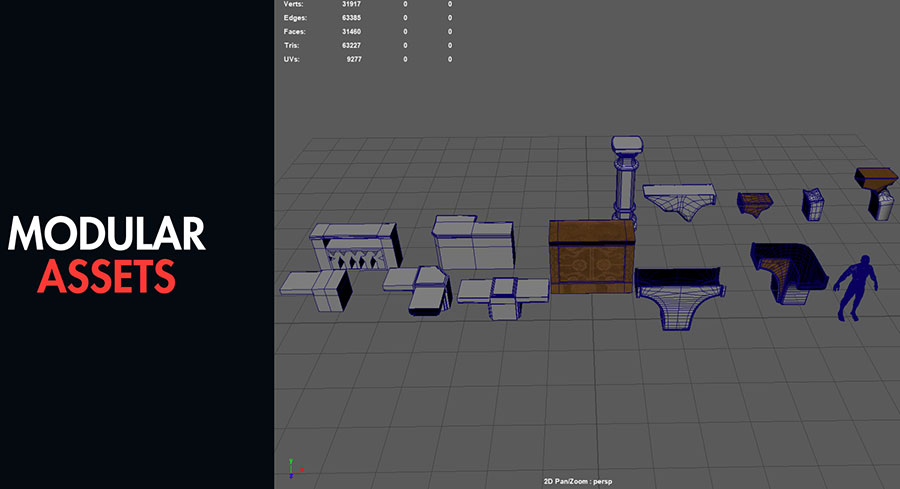
The prop set included:
- Furniture (rope beds, carved chairs, chests)
- Lighting (oil lamps, torch brackets)
- Domestic and architectural elements
- Narrative props tied to story progression
All assets were built at a medium-poly standard, optimized for first-person interaction with clean topology for proper baking.
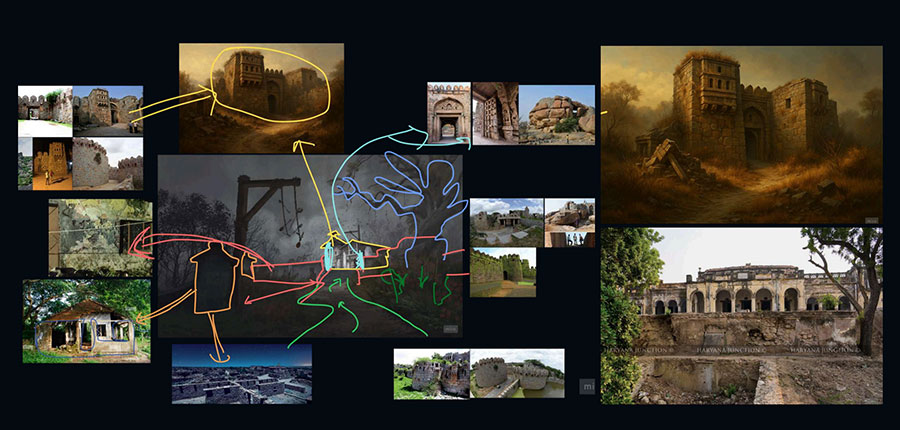
The Concept Scribble Phase
One of the most valuable lessons from this project was the importance of quick concept work.
Before committing to production, we used fast sketches and annotated overlays to test ideas:
- Does this layout communicate scale?
- Does it support exploration and storytelling?
A five-minute sketch can solve problems that might otherwise take hours in 3D.
These scribbles also helped establish a shared visual language across the team.
What the Haveli Taught Me About Horror
This project reinforced a key idea:
The best horror isn’t what you show—it’s what you build.
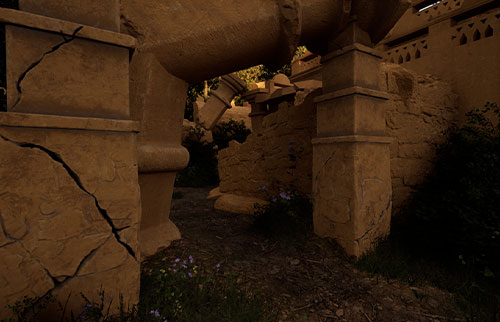
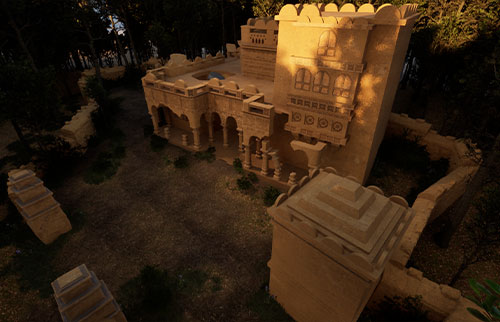
The Singhania Haveli is terrifying because it is a beautiful ruin.
You can see what it once was—and that contrast creates horror.
Art direction decisions supported this:
- Cool desaturated tones
- Warm amber lighting
- Realistic moonlight on sandstone
- Dynamic global illumination
Unreal Engine 5, especially Nanite, made this possible—allowing high-detail geometry without compromising performance.

Graduation Showcase
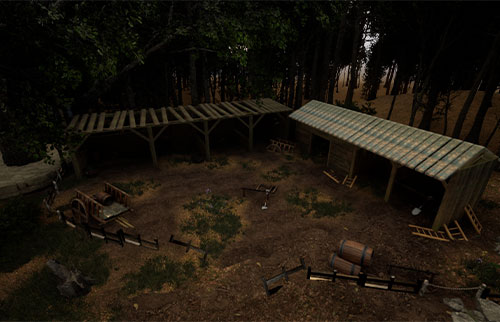
Presenting Rajpura Files ICAT College Graduation Showcase held at Mantri Square Mall allowed players to step inside the haveli and experience its atmosphere firsthand. Watching them explore the space, react to the environmental details, and absorb the slow-building tension provided valuable insights into immersion, visual storytelling, and spatial clarity transforming the project into a real-world, player-tested experience.
Conclusion
The current version stands as a vertical slice and proof of concept, with the next steps focused on completing the haveli environment, implementing memory sequences, finalizing Dev Singhania’s MetaHuman, integrating audio with FMOD, and building a full playable demo. With potential publishers like Fellow Traveller, Raw Fury, and Devolver Digital in sight, the goal is to bring Rajpura Files to players who have never experienced horror rooted in their own culture and to show that the scariest places are often those shaped by history.
Explore more student project blogs to see how innovative ideas are brought to life.