
Explore the making of What's Inside (VR)—a psychological horror VR game built by ICAT College students. Discover its core mechanics, immersive design, and how uncertainty drives player experience.
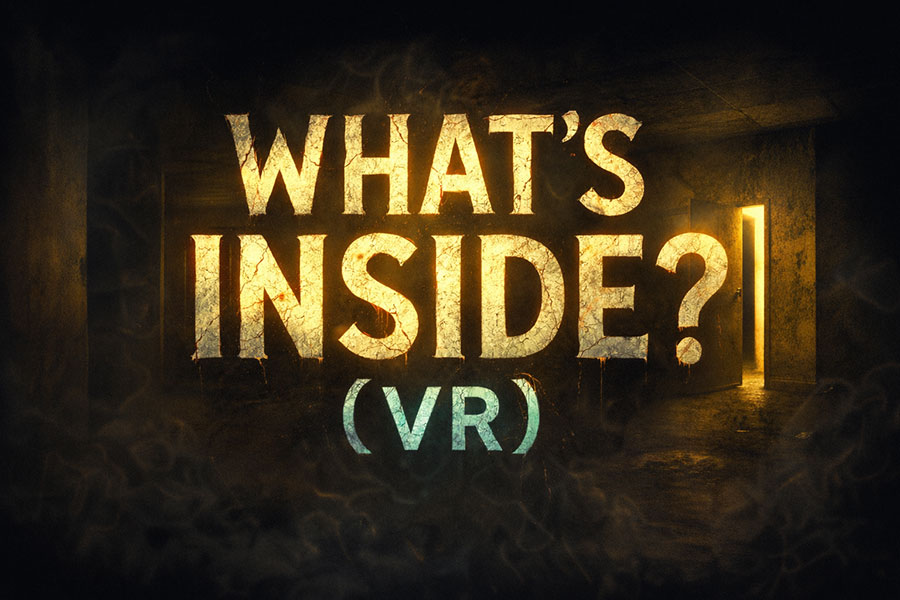
What's Inside (VR): Designing Fear Through Uncertainty
Every year, horror games attempt to terrify players through scripted events and predictable patterns. But here, in the quiet intensity of a VR workspace, surrounded by looping corridors and flickering lights, we wanted to break that familiarity.
We didn't want players to simply experience fear
We wanted them to live inside uncertainty.
Transitioning from traditional game design approaches into immersive VR, What's Inside (VR) was built as a psychological experiment. A space where logic is unreliable, time is unforgiving, and every decision carries weight.
This is not just an escape room.
It is a test of instinct, perception, and control.
Phase 1: Designing Uncertainty (Core Mechanic)
Most puzzle games reward certainty. We chose the opposite.
At the heart of What's Inside (VR) lies a simple but brutal system:
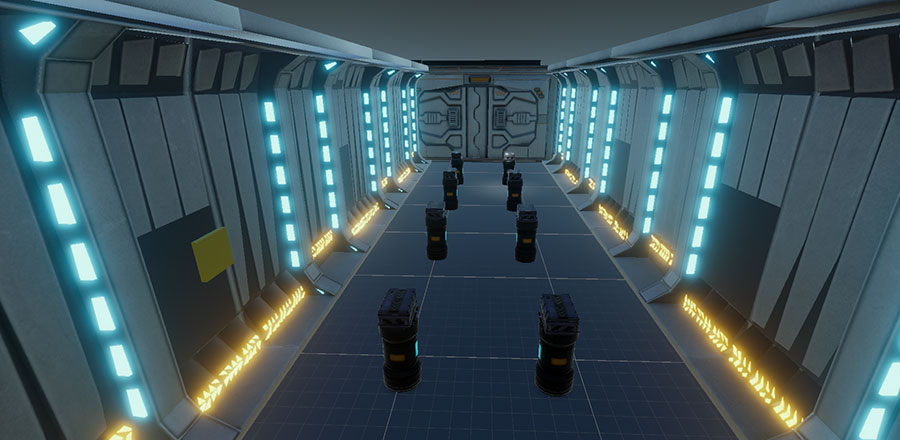
Eight pillars. Four real tickets. Four lies.
The player steps into an enclosed industrial corridor. The timer begins instantly. There is no tutorial, no pause—only pressure.
Each decision becomes a gamble.
The Mechanics of Trust and Risk
- Ticket System: Only half the choices are correct
- Immediate Consequence: Fake tickets trigger hazards instantly
- Time Pressure: Every second lost increases panic
Unlike traditional puzzles, the solution isn't just logic, it's intuition under stress.
Phase 2: Building Physical Interaction (VR Immersion)
We wanted players to feel every action, not just press buttons.
Using VR interaction systems, every mechanic became physical:
- Reaching out to grab tickets
- Aligning hands to insert them into slots
- Reacting in real-time to environmental threats
The Mechanics of Embodiment
- Hand Tracking: Direct interaction with objects
- Precision-Based Actions: No auto-complete inputs
- Reactive Gameplay: Hazards demand immediate physical response
In VR, hesitation is not just a delay
It is a failure.
Phase 3: Engineering Hazards (Punishment System)
Fear alone is not enough. Consequence creates tension.
Each incorrect decision introduces a unique hazard, forcing players to adapt instantly.
The Language of Danger
- Bomb: A ticking countdown forces urgent action
- Ice: Total immobilization while time slips away
- Shock: Environmental interaction becomes survival
- Flood: Space itself turns against the player
- Blackout: Vision is stripped away completely
Each hazard is not just an obstacle, it is a disruption of control.
We designed them to attack different aspects of the player:
- Reflex
- Awareness
- Movement
- Orientation
Phase 4: Shaping the Environment (Level Progression)
The world itself evolves alongside the player.
Each level introduces not just new visuals, but new psychological pressure.
The Descent
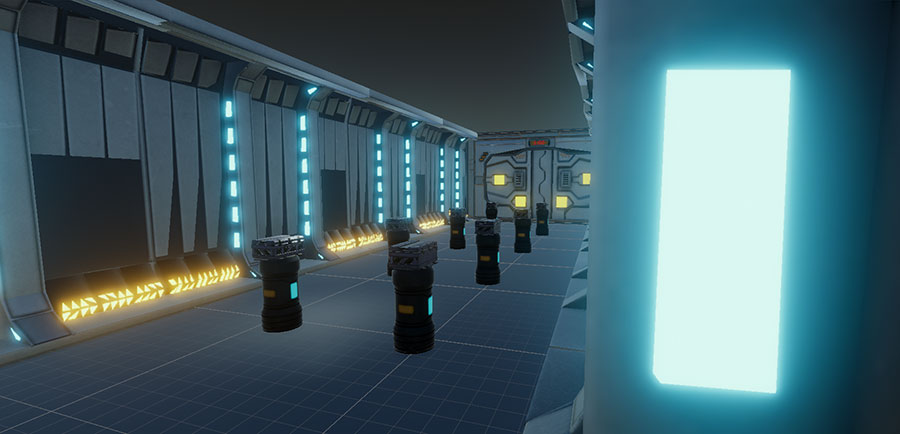
- Level 1 – Baseline Corridor: A controlled introduction. Warm lighting, simple threats. A false sense of security.
- Level 2 – Maintenance Room: Cold, mechanical, unpredictable. Sparks and instability enter the experience.
- Level 3 – Flooded Corridor: Movement slows. The environment resists you.
- Level 4 – Escape Stairs: Darkness dominates. Memory replaces vision.
- Level 5 – The Finale: Reality collapses. Space distorts. All rules break.
Each space is designed not just visually, but psychologically to disorient, isolate, and overwhelm.
Phase 5: Breaking Perception (The Finale)
At the final stage, the game stops teaching and starts testing.
All hazards return. All systems overlap.
And a new force emerges:
Gravity Distortion
The player loses their sense of direction.
Walls shift. The body floats. Orientation becomes unreliable.
This is where learned behavior meets chaos.
The player is no longer solving puzzles they are fighting to maintain control.
The Gameplay Loop as Pressure
Unlike traditional progression systems, What's Inside (VR) uses layered repetition.
Each level:
- Reinforces previous mechanics
- Introduces new variables
- Increases cognitive load
The timer remains constant but the experience becomes heavier.
The Player Experience
We didn't design this game to be "fun" in the traditional sense.
We designed it to make players feel:
- Tension
- Urgency
- Disorientation
- Isolation
- Relief
The moment the exit door opens is not victory, it is a relief.
The Climax: A Psychological Escape
The true narrative of What's Inside (VR) unfolds in the final seconds of each level.
The timer is nearly gone.
Hands are shaking.
A decision must be made.
Insert the wrong ticket and everything collapses.
Choose correctly and you escape.
For a developer, the journey from concept to this moment is a reminder of what immersive design can achieve.
Not just interaction but emotion.
Not just gameplay but experience.
Graduation Showcase
Presenting What's Inside (VR) at the ICAT College Graduation Showcase held at Mantri Square Mall allowed real players to experience the chaos firsthand. Watching them laugh, compete, and react to the ragdoll physics provided valuable insights into gameplay engagement and intuitiveness.
This experience helped refine key areas such as control responsiveness, gameplay clarity, and player interaction balance transforming the project from just an academic submission into a real-world, user-tested game.
Conclusion
What's Inside (VR) began as an idea to challenge traditional horror design but evolved into a deeper exploration of how uncertainty shapes player behavior, pressure influences decisions, and immersion transforms simple mechanics into emotional experiences. From concept to real player interaction, it shows that impactful game design is not just about systems or visuals, but about what the player feels in the moment because in the end, it's not what the player sees, but what they experience under pressure. Projects like this reflect the hands-on, experience-driven learning approach at ICAT College of Design & Media, where students explore Game Design, VR development, and interactive storytelling through practical implementation to create meaningful player experiences.
Explore more student project blogs to see how innovative ideas are brought to life.