

In a world buzzing with flashy tech gadgets and AI breakthroughs, the best innovations don't dazzle with complexity – they connect deeply with everyday people. Human-centred design (HCD) flips the script on traditional invention. It puts human needs, feelings, and real-life struggles right at the heart of the process. Think of it as designing not for people, but with them. This approach turns good ideas into game-changers.
A people-first revolution
HCD did not pop up overnight. It started in 1958 at Stanford University. There, Professor John E Arnold shook up engineering classes by arguing that designs should serve human needs first – not just crank out efficient machines.
Later, design theorists Horst Rittel and Melvin Webber coined the term "wicked problems". These are messy issues like poverty, climate change, or urban congestion. They are tangled, ever-shifting, and solving one bit often uncovers more headaches. Straight-line engineering? No match. HCD stepped in with its flexible, empathy-driven cycle: observe, ideate, prototype, test, repeat.
Today, HCD draws from fields like psychology and anthropology. It uses tools like empathy maps – visual sketches of users' thoughts, pains, and joys – to build deeper insights. This human touch makes solutions resilient in a chaotic world.
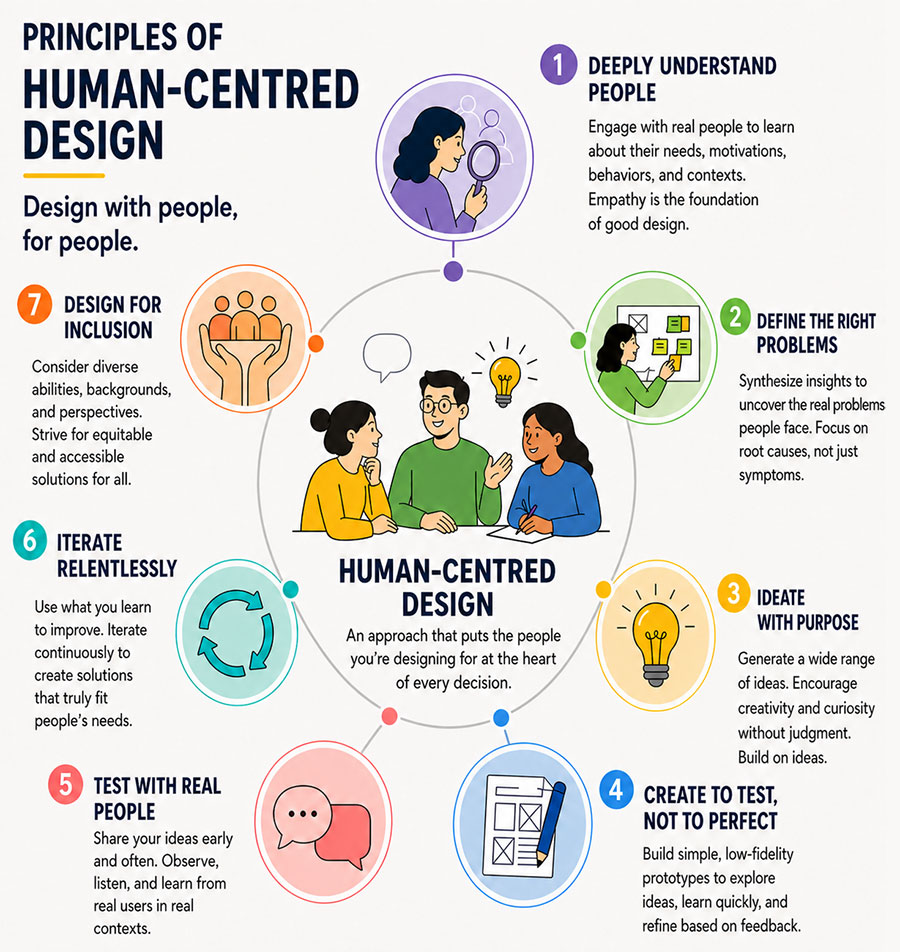
What makes HCD tick?
At its core, HCD is a mindset shift. Designers dive into users' worlds through interviews, shadowing, and "day-in-the-life" observations. Key pillars include:
- Grasping behaviours, emotions, and surroundings.
- Keeping users involved from brainstorm to launch.
- Aiming beyond "usable" to "life-improving".
Unlike narrow user-centred design (think app buttons), HCD zooms out. It factors in culture, motivations, and social vibes. Does this tool ease a single mom's chaotic mornings? Does it respect elders' tech fears? HCD asks the big "why" to craft emotionally smart fixes.
Why HCD beats tech-first thinking?
Old-school product design chases specs, profits, or buzz. It risks flops – like gadgets gathering dust. HCD slashes those pitfalls:
- Cuts costs: Test cheap prototypes early; dodge expensive recalls.
- Boosts uptake: Matches real needs, so people actually use it.
- Enhances joy: Tackles feelings, not just functions.
- Hits roots: Fixes causes, not band-aids.
Studies show projects using it see 30-50% higher success rates. It is sustainable innovation that pays off long-term.
Empathy: the secret sauce
Empathy is not fluffy – it is fuel. Forget dry stats. HCD pros uncover what lights people up: hidden frustrations (like clunky bank apps), delights (seamless rideshares), and values (eco-friendly packaging).
Take journey mapping: Chart a user's path, spotting pain points like endless forms. This builds resonance. As designer Indi Young says, "Empathy bridges the gap between heads and hearts".
Nail the problem
Bad problem statements lock you in: "Build a better chair". HCD reframes: "How might we help remote workers stay comfortable during long video calls?" It is action-focused, open, why-driven. Groups like DC Design swear by this – it sparks wild creativity while staying user-true.
Bridging the empathy divide
Big companies often lose touch – execs in towers, users on the ground. HCD closes that with co-creation: Workshops where nurses redesign hospital tools or farmers tweak apps. UNICEF pushes this for global aid, involving kids in play-based learning designs. Result? Inclusive wins that last.
HCD stars in action
Real wins prove it:
- Airbnb: Hosts and guests built trust via photo tips and reviews – boom, a sharing empire.
- Apple: Intuitive gadgets like the iPhone feel like magic because Steve Jobs obsessed over "delight".
- Dyson: James Dyson drew inspiration from observing mothers vacuuming, and created powerful bagless vacuum cleaners.
- Amazon: Endless tweaks from user data make shopping addictive-yet-easy.
- LinkedIn: Feedback loops turned it into a career lifeline.
Core rules to live by
Four pillars guide HCD:
- People first: Dive into real lives for relevance.
- Right problem: Hunt root causes.
- Big-picture view: Map systems, not silos.
- Iterate simply: Prototype fast, refine forever.
Making the switch
Go HCD with these shifts:
- Swap guesses for field research.
- Loop in feedback constantly.
- Build diverse teams – engineers, psychologists, users.
- Use ethnography (live observation) and prototypes.
Tools like Figma for quick mocks speed it up. Companies like Google embed HCD in "Design Sprints" – for instance, five-day idea blitzes.
Designing for us all
Technology is becoming a part of our lives every day. We have smart cities and computers that can think like people. This means that Human-Centred Design is becoming really important. It is not about making things, it is about people. Don Norman, who is like a father to User Experience, said it best: "Make things that people will love".
Human-Centred Design shows us that when we care about people and try to understand them we can make things that help people. It takes problems. Turn them into solutions that make a difference in people's lives.